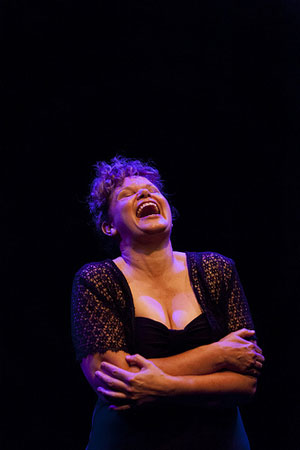
 Left – Leah Purcell. Cover – Nardi Simpson & Leah Purcell. Photos – Brett Boardman
Masterfully performed by Leah Purcell, Don't Take Your Love to Town is a warm and moving story of one woman's determination to carry on and, ultimately triumph against the odds. It is based on the 1988 memoir of Ruby Langford Ginibi, starting with her birth in 1934 on the Box Ridge mission, through her struggles to survive as a single mother with nine kids, to middle age.
While the show only covers Ruby Langford Ginibi's life up to the point where she wrote the memoir, she led a second life following its publication as a leading voice for indigenous issues, writing books, lecturing and receiving two honourary doctorates.
Eamon Flack and Leah Purcell have adapted Langford's acclaimed autobiography, using Langford's own words for the text of the play. They have successfully replicated the candour and humour of Langford's tone which, gratifyingly, is never self pitying or sentimental. Though much of the material depicts a life of hardship and tragedy, it also celebrates the value of family and the importance of having the will to just keep going.
On an almost bare stage Leah Purcell delivers a touching and compelling performance depicting Langford Ginibi's life, with little more than some backup by musician Nardi Simpson. A two hour monologue is a significant challenge but Purcell takes it in her stride and keeps the audience enraptured until the very last minute.
Leah Purcell has the gift of making things appear deceptively simple. Two hours on stage, effectively alone, is anything but simple. Her physical and vocal skills have been honed over the last 20 years, but what makes her so compelling is her capacity for intimacy with the audience. She establishes it within the first minutes. Purcell creates a level of familiarity with the audience that belies a highly technical performance. As Ruby, Purcell has the easy manner of someone who likes to share a joke or a story. She also has a killer capacity to express Ruby's pain. Purcell is very good at laying bare the soul of her character, of expressing their anguish with frightening honesty and then, in a flash, covering it up with stoic pragmatism or a laugh. Did I mention that she directed this too?
Langford wanted to tell her story to offer insights into indigenous life to the broader community. What she created was a work with both specific and universal resonances: what it was like to be a poor, indigenous woman in Australia last century. The strength of her story is that it is both intensely personal and also a work of social and political history. Langford Ginibi shares experiences common to so many indigenous women, and beyond. She tells not only her story, but the stories of her aunties, cousins, girlfriends and neighbours. She sets her personal story against the backdrop of larger political context: the early glimmers of indigenous activism with Charles Perkins and, later the mounting concerns of Aboriginal deaths in custody.
Don't Take Your Love to Town is rich with the sounds, smells and experiences of Langford Ginibi's life: early memories of seasonal cherry pies, fresh corn and childhood swims in the river in Casino. Purcell regales us with the innocence of Langford's courting and the surprise of an early pregnancy. There are vivid images of the backbreaking and unforgiving work constructing fences, sleeping in sackcloth tents, the hardship brought about by poverty, a succession of hopeless, violent, dissolute partners, bar room fights and the heartbreak of loss.
Purcell describes Langford Ginibi's life yo-yoing back and forth between bunking down with family in Redfern and northern NSW with various partners and having a string of babies along the way. The deep sense of displacement pervades the show. Purcell describes Langford's difficulty in trying to straddle two cultures yet not truly fitting into either and how this takes its toll in so many ways. She describes lives cut short, others who succumb to crime, others who struggle on, disaffected. Langford Ginibi is not afraid to depict herself in a poor light, candidly describing the alcoholism and brawling of her middle years and Purcell delivers these stories with a similar absence of judgment.
If you are looking for a Christmas gift that offers generosity and wisdom, this might be just the ticket.
Belvoir presents
Don't Take Your Love to Town
From the book by Ruby Langford Ginibi | Adapted by Eamon Flack & Leah Purcell
Venue: Downstairs Theatre | Belvoir St Surry Hills NSW
Dates: 29 Nov 2012 – 6 Jan 2013
Tickets: $42 – $32
Bookings: http://belvoir.com.au